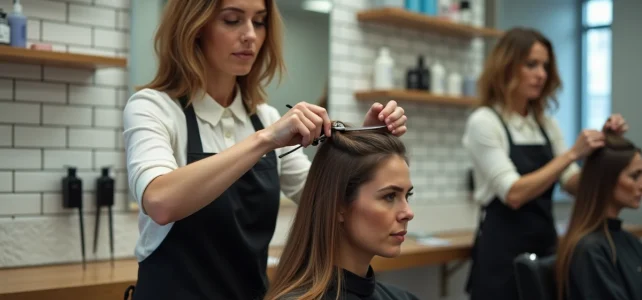
The butterfly cut refers to a multi-layered gradient where the shortest strands frame the face while the lengths are preserved at the back. The result resembles butterfly wings due to the volume concentrated at the top of the head and the tips cascading down. This technique, inherited from the layered cuts of the 70s and 90s, has regained strong visibility on social media in recent seasons.
Butterfly cut on wavy hair: why dry cutting changes everything
Most guides present the butterfly cut as a style reserved for straight or slightly wavy hair. This view is reductive. Texture-specialized hairstylists now recommend dry cutting for wavy hair, including on a butterfly-type gradient.
On wet hair, the waves stretch and distort the perception of actual length. Once dry, the hair rises, and the layers intended at chin height can end up at cheekbone level. Dry cutting allows for sculpting the volume as it will be worn daily, taking into account the natural bounce of the waves.
This approach is particularly relevant for fine wavy hair, a hair profile for which the butterfly cut is starting to be mentioned alongside the shag or wavy bob as a solution for achieving visual density. Additionally, La Petite Emma’s methods and tips detail how to formulate your request at the salon to achieve the right result.
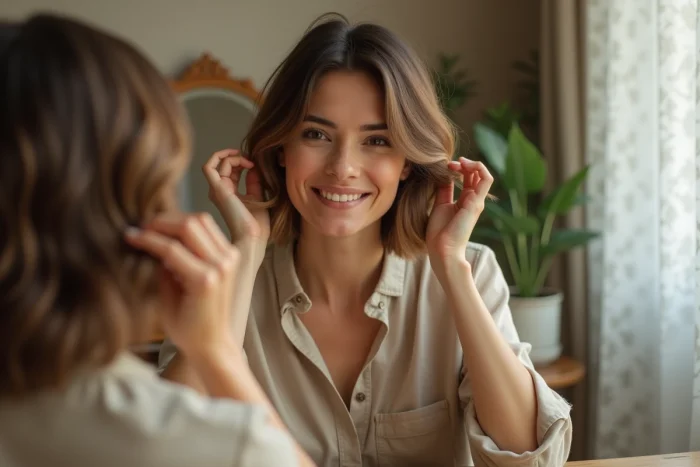
Butterfly gradient technique: layer structure and volume effect
The principle is based on a layering of strands at very different lengths. The top layer, the shortest, is generally positioned between the chin and shoulders. It creates the visible volume from the front. The lower layers maintain the initial length, giving that characteristic cascading silhouette.
Center part and curtain bangs
The butterfly cut is often accompanied by a center part paired with curtain bangs. This fringe, cut in a triangle from the top of the head, frames the face on either side. It softens features on square faces and balances elongated faces by adding lateral volume.
What distinguishes the butterfly cut from the shag
The shag also uses layers, but with more abrupt transitions and a deliberately deconstructed look. The butterfly cut aims for a more fluid, “blended” result. The demarcations between the layers remain visible (this is what produces the butterfly effect), but the transitions are worked with scissors to remain soft rather than choppy.
Styling the butterfly cut: methods with and without heat
The butterfly gradient makes sense once styled. Without shaping, the layers can appear flat or create unflattering demarcations, especially on very straight hair.
- With a flat iron or round brush: work the tips of the upper layers outward to enhance the “wings” effect. The lengths underneath remain smooth or slightly curved inward.
- With Velcro rollers: place the rollers on the upper layers, at the roots, to boost volume without excessive heat. This technique works well for medium-length and thick hair.
- Without heat: apply a texturizing product on damp hair, twist the strands of the upper layers, and let air dry. The result is more natural, with a soft movement that works well on light waves.
The choice of method mainly depends on the starting texture. Fine hair benefits more from blow-drying, which adds structured volume. Thick or wavy hair can suffice with air drying and a good styling product.
Maintenance of the butterfly gradient: cutting frequency and suitable care
A layered gradient loses its shape more quickly than a straight cut. The upper layers, being shorter, grow and gradually blend with the intermediate layers. A refresh every two to three months is recommended by texture specialists to maintain the structure of the butterfly cut.
Between salon visits, care is as important as the cut. The tips of the upper layers, more exposed to friction and styling, wear out first. A light serum or oil applied to the lengths limits breakage and maintains the fluidity of movement between the layers.
Colored hair and the butterfly cut
Coloring techniques like balayage enhance the depth effect of the gradient. The upper layers, often lighter due to sun exposure or balayage, catch the light and reinforce the impression of volume and movement between the different layers. A moisturizing treatment suitable for colored hair protects this visual dimension.
Butterfly cut and face shape: successful combinations
The butterfly cut does not have the same effect depending on the face shape. Square faces benefit from the curtain bangs and lateral layers, which break the angularity of the jaw. Elongated faces gain harmony from the volume concentrated at the cheekbones.
For round faces, caution is advised. Layers that are too short at the cheeks accentuate roundness instead of slimming it. In this case, starting the gradient below the chin rather than at the cheekbones balances the proportions.
The overall length also plays a role. On medium-length hair, the butterfly effect remains subtle and easy to manage. On very long hair, the contrast between the short layers on top and the lengths underneath is more dramatic but requires more regular styling to avoid a messy appearance.
The butterfly cut remains a technical style whose result depends as much on hair texture as on face shape. Bringing reference photos to the salon, taken of models with a similar morphology, remains the most reliable way to achieve a butterfly gradient suited to one’s own structure.