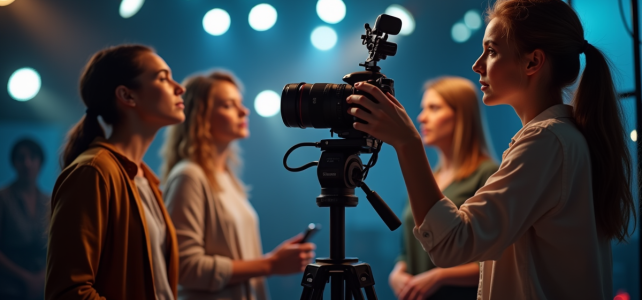
Scroll through the credits and count: how many women behind these names, how many familiar faces ignored under the spotlight? The awards of the small screen showcase lists where a few men bask in the limelight, while so many co-creators, present since the beginnings, find themselves relegated to the bottom of the poster.
Decisive contributions, whether in writing, production, or applied research in audiovisual media, appear nowhere in textbooks, nor even in databases intended for the general public. Following the thread of these trajectories reveals strategies of invisibility and persistent hierarchies, which resist despite the undeniable mark these women have left on the history of the medium.
When the history of cinema and science forgets its pioneers: a look at the invisibility of women
Few works give due recognition to the pioneers of cinema and science. From the first films, some women signed the invention, dared to direct, and brought their perspective behind the camera; then the light fades, their names blur while others vie for the spotlight. The same story repeats in laboratories or in NASA offices, where women advance without ever receiving full recognition from their peers or the general public.
The gap widens between the dominant narrative and a more nuanced reality: the place of women in the history of cinema and research remains largely underexposed. French and European institutions take a considerable amount of time to do justice to these exceptional trajectories. Biographies and textbooks barely skim their contributions, citing in the margins what should carry weight. Katherine Johnson, a brilliant mathematician at NASA, only gains national notoriety through the lens of the film “Hidden Figures,” brilliantly portrayed on screen, but long ignored by the general public.
This process of erasure has a name, even a face: the story of Marjorie Lynn Noe is its symbol. Always associated with Michael Landon, she embodies those women who, despite unwavering presence and support, remain confined to the background. This phenomenon is highlighted in a particularly enlightening article on Le Off.
Several situations testify to these organized oversights:
- First woman director in Europe, first scientists at NASA, or even French figures erased from the public narrative after World War II: so many fates erased.
- Learned societies, festival committees, or encyclopedias wait, postpone, or minimize the significance and legacy of these women.
It took the insistence of historians, the courage of witnesses, and the slow opening of archives for the contributions of women scientists and audiovisual professionals to begin to reappear. This movement is progressing, but the resistance of institutions remains palpable.

Unknown portraits and legacies: these women who shaped the screen and research
Diving into the journeys of these women reveals a whole universe of richness and tenacity. Whether they work in a studio or in the shadows of a laboratory, their ability to defy the codes inspires lasting admiration. Yet, their names rarely break through the surface of official works, and their very real innovations remain in the background.
Here are some striking examples of this paradox:
- The first woman to have signed a film in France receives only a few footnotes, even though she paved the way long before the wave of American studios settled in the capital.
- During World War II, in London, scientists work tirelessly, never being associated with the great victories primarily attributed to military leaders. Their contributions fade behind the great political figures.
Studios are not exempt from this rule. Many actresses and technicians have pushed the boundaries of creation, participated in reinventing storytelling, and left their mark on the evolution of images and narratives. The roles embodied today by Taraji P. Henson, Octavia Spencer, or Janelle Monae are living proof: it took the cinema’s gaze upon itself to begin to tell the reality of women scientists and creatives.
There is here a silent, patient, tenacious force. Actresses, researchers, technicians, they are hundreds who have transformed the face of cinema history and science through their work, inventiveness, and perseverance. With each name rediscovered, an injustice dissipates, and in this renewed light, the scene expands. The question remains who, tomorrow, will continue this movement so that other narratives, long kept at bay, finally take their place.