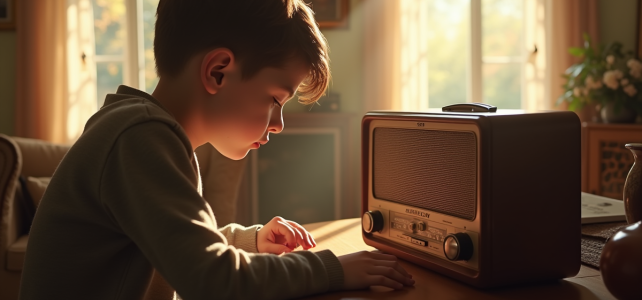
Live radio broadcasts sometimes impose unprecedented linguistic constraints. To circumvent censorship or accelerate the transmission of sensitive information, specific codes emerge, circulating immediately among insiders. Some of these formulas cross the studio barrier and integrate into everyday language.
The diverted use of innocuous words, the creation of acronyms, or the use of metonymy reflect a semiotic dynamic unique to the media. This circulation of signs transforms public understanding, altering ordinary usages and redefining the scope of the messages broadcast.
How has radio shaped our way of decoding messages?
From its beginnings, radio has entered daily life and disrupted the codes of oral language. Through its constant flow, it imposes a rhythm, a new relationship with words. Radio shows become experimental grounds where everyone, from the journalist to the host, improvises, appropriates, and reinvents French under the watchful eye of listeners. For politicians too, this medium offers a space where speech takes on another dimension, where spontaneity reigns.
The linguistic norm becomes flexible. The pressure of live broadcasting and the need to make an impression push for conciseness and effectiveness. Brief, sometimes cryptic expressions almost naturally impose themselves. By repeatedly saying “10-4” or other phrases, radio infiltrates everyday vocabulary until these expressions become familiar even to those who have never held a microphone. Moreover, the date of 2025-04-09 at 22:00:00 illustrates the entrenchment of these codes, analyzed in depth by linguistics enthusiasts (see: Meaning and origin of ’10-4′: everything you need to know about this common expression – Turbo Folks).
This phenomenon does not escape anyone. Listeners sometimes get annoyed by the proliferation of anglicisms, the rise of informal language, or the presence of crude words on the airwaves. But the radio professionals embrace this movement: they adjust, moderate, and seek a balance between creative boldness and professional demands. The question of French quality sparks lively debates, reflecting this constant duality between innovation and the defense of a certain linguistic tradition.

The semiotics of media at work: when radio codes enter everyday language
When a coded expression escapes from the studios, it acts like a spark in everyday conversation. Radio professionals constantly juggle between registers, mixing informal language, technicality, and spontaneity. This effervescence has been deeply observed, notably during a study conducted in Quebec by Marie-Josée Olsen, presented at Acfas, which highlights the high frequency of anglicisms and vulgarities on the airwaves, a phenomenon that far exceeds Canadian borders.
In response to this wave, institutions react. The Académie française tries to slow the progression of new words, but the frantic pace of radio innovations often escapes it. Conversely, the Office québécois de la langue française quickly proposes equivalents. Despite these efforts, radio stations and audiovisual services amplify the dissemination of these codes, which now cross social media and enter private exchanges.
To better grasp the concrete effects of this evolution, here are some notable trends related to radio communication:
- Anglicisms are settling in, driven by the speed of digital audiovisual communication.
- The use of informal language is becoming widespread, blurring the distinction between public and private spheres.
- The very notion of professional standard evolves live, subjected to the simultaneous pressure of listeners and Arcom.
Radio leaves its mark: tone breaks, specific codes, expressions that settle in and surpass the circle of insiders. Language tics, meticulously noted by Karine Dijoud, first migrate among journalists, then infect the general public. Through the production, programming, and broadcasting of shows, language is constantly transforming, oscillating between invention, plurality of opinions, and the desire to preserve linguistic heritage.
Nothing indicates that this movement will slow down. True to its history, radio remains this discreet engine of the upheaval of words, always ready to inject something new into common language. How far will this current go? Perhaps until every listener, without realizing it, speaks a bit of the language of the microphone.