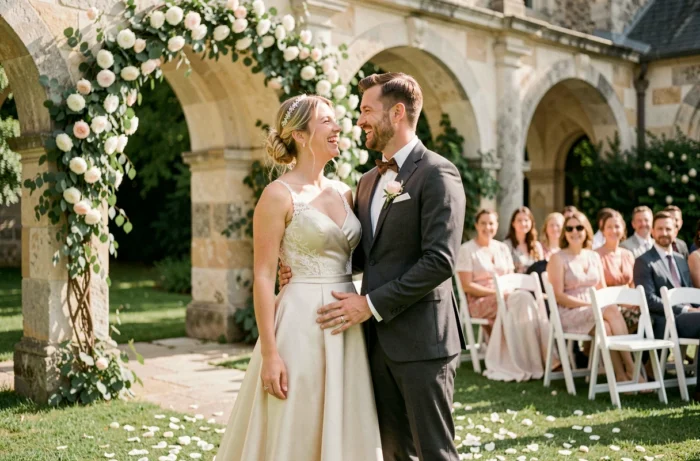
Organizing a wedding this year means facing a paradox. Couples want more personal, sincere celebrations, but the available options have never been so numerous. Three main trends clearly emerge: the voluntary reduction of the guest list, the extension of festivities over two days, and the emergence of new service providers related to digital content.
Quiet wedding: why reducing the guest list changes everything
The term “quiet wedding” refers to a deliberately restricted wedding, where the couple limits the number of guests to prioritize the quality of each shared moment. According to TF1 Info, which reports on the sector report by Mariages.net published in March 2026, this trend reflects a budgetary trade-off as much as an emotional choice.
Specifically, inviting fewer people allows for reallocating the budget per head. Instead of feeding a hundred guests with a standard menu, a couple can offer forty close friends a reception with a high-end caterer, a unique venue, and carefully curated decor.
This choice also affects the atmosphere of the ceremony. With a smaller group, conversations are longer, speeches are more personal, and the couple spends real time with each guest. This is a point that many couples regret after a large wedding: having barely spoken to half of the attendees. Among the articles published on Univers Mariage, several testimonials confirm that this approach transforms the dynamics of the day.
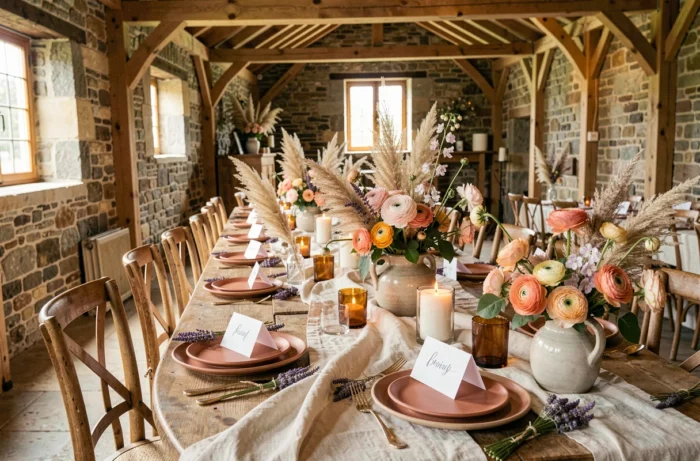
Two-day wedding: budget and logistics to anticipate
Extending the wedding beyond a single day is no longer reserved for lavish celebrations. The Vows & Venues study by Hyatt, published in September 2026, indicates that 56% of respondents wish to organize a brunch the day after the reception.
Why is this format so appealing? Because it solves a concrete problem. The big day goes by very quickly. The couple rushes from one moment to another, between the ceremony, photos, cocktail hour, and the evening party. The brunch the next day offers a relaxed space to reconnect with loved ones in a laid-back setting.
Additional budget items to consider
Adding a second day is not just about ordering croissants. Several expenses arise and must be included in the preparations from the start:
- Accommodation for guests for an additional night, especially if the reception venue is remote. Negotiating a block of rooms with a nearby hotel remains the simplest solution
- The caterer or brunch service, which represents a separate budget item. Some venues offer an integrated package, while others do not
- The availability of the venue itself: not all estates allow for two-day occupancy, and rental rates can double
Check the venue’s availability for two days before signing. This is the most common sticking point, and it is the least negotiable once the contract is validated.
Wedding content creator: a full-fledged service provider
You may have noticed that wedding videos on social media no longer resemble traditional wedding films? Short, quickly edited sequences published the same evening. This format has given rise to a new profession in wedding planning.
According to the Vows & Venues study by Hyatt, reported by the Journal des Femmes in September 2026, 35% of engaged couples favor a dedicated content creator, distinct from the photographer and videographer. Their role: to produce short content for social media and capture behind-the-scenes moments in real-time.
Content creator or photographer: two different missions
The photographer works over a longer duration. They compose carefully crafted images, edited in post-production, delivered several weeks after the reception. The content creator, on the other hand, works instantaneously. They film with a smartphone or lightweight camera, edit on-site, and publish the same day.
The two do not replace each other. A couple who values a classic photo album and same-day stories needs both service providers. The budget is affected, but this service generally costs less than a traditional videographer because the deliverable is shorter and does not require lengthy editing.
Personal data of guests: an often overlooked angle
Digital tools are multiplying in wedding planning: dedicated websites, online RSVP forms, dematerialized gift lists, photo-sharing apps. Each tool collects personal data about your guests (names, addresses, dietary preferences, banking details for gifts).
The CNIL regularly reminds us of the obligations related to the collection of personal data, even in a private context when a third-party service is involved. Before choosing a platform, check where the data is hosted and whether the provider complies with GDPR.
Prefer platforms hosted in Europe and read the terms of use regarding the resale or sharing of data. Some free services monetize by exploiting your guests’ information, which can pose both ethical and legal issues.
Tips for choosing wedding service providers without making mistakes
Selecting service providers remains the crux of any wedding project. Among the most useful reflexes: request a detailed quote item by item, demand verifiable references, and clarify cancellation conditions.
The choice of reception venue determines a large part of the other decisions. A venue that imposes its caterer, DJ, or florist limits your flexibility. Conversely, a “blank” venue offers total freedom but requires more coordination.
Customization and tight budgets dominate couples’ concerns. Service providers who offer modular packages, adaptable to the number of guests and the chosen format (one day or two), stand out.
Planning a wedding this year involves more decisive trade-offs than before. Fewer guests but better treated, longer festivities but better budgeted, new service providers but needing oversight. Every decision made early frees up time and energy for the only goal that matters: enjoying the day.