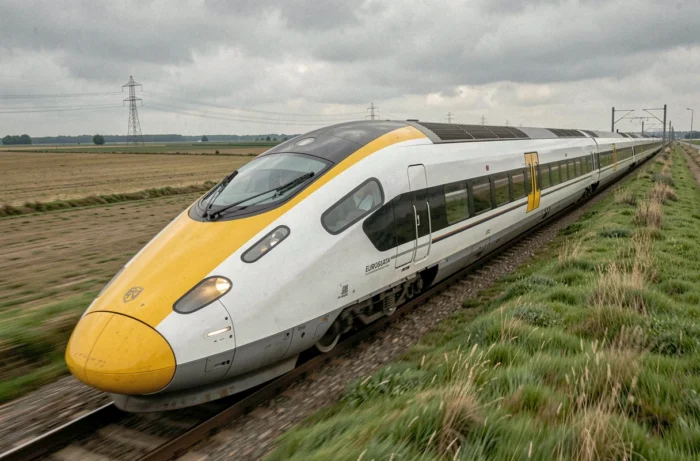
The Eurostar network, since the merger with Thalys in October 2023, covers five countries on a high-speed rail network connecting Paris, London, Brussels, Amsterdam, and several German cities. Understanding the complete route and its operational constraints allows for anticipating actual travel times, useful connections, and bottlenecks related to border controls.
EES Controls at St Pancras: What Changes for Trips to London
The European Entry/Exit System (EES), gradually deployed since October 2025, records the entries and exits of non-European nationals with biometric data collection at the border. For Eurostar, these formalities are carried out on the British side, at St Pancras station, before boarding, due to the adjacent French controls.
The removal of the flexibility period in the application of biometric controls increases the risk of queues. The implementation remains operationally uneven at St Pancras: depending on the crowd and the functioning of the equipment, the experience varies from day to day, even for the same journey.
We recommend arriving at least one hour before departure for any trip from London. For departures from Paris-Nord to London, the British border control also takes place before boarding, but the flows are generally better absorbed due to the available space at the station. The situation becomes critical during school holidays and extended weekends.
For a detailed view of the Eurostar route and destinations in Europe, the network mapping helps visualize the border control points on each connection.

Eurostar Route from Paris-Nord: Direct Connections and Strategic Transfers
Paris-Nord serves as the central hub of the network. Direct connections depart towards four main axes.
- Cross-Channel Axis: Paris-Nord to London St Pancras, via the Channel Tunnel and LGV 1 on the French side, then HS1 on the British side. The train sometimes stops at Lille-Europe and Calais-Fréthun along the way.
- North Axis: Paris-Nord to Brussels-Midi, with a direct extension to Amsterdam Centraal. Some trains make a stop at Rotterdam Centraal. The line takes the LGV Nord and then the Belgian LGV to Brussels.
- German Axis: from Brussels, direct connections link Cologne via Liège and Aachen. These trains operate under the Eurostar brand since the merger with Thalys.
- Seasonal Eurostar Snow Axis: in winter, trains connect London to ski resorts in the French Alps, with stops in the valley.
Lille-Europe plays a role as a secondary hub. From Lille, connections with TGV INOUI allow access to the Eurostar network without going through Paris. Bruges, a highly sought-after city by travelers, can be reached via a short transfer from Brussels-Midi or Lille.
Eurostar Destinations in Belgium, the Netherlands, and Germany: Line Specificities
Brussels-Midi remains the main continental hub of the network. It is the only station where the three axes (cross-Channel, north, and German) converge. A traveler departing from London can reach Amsterdam or Cologne the same day with a transfer in Brussels, but sufficient time must be allowed: cross-Channel security checks are not reciprocal with continental lines.
Amsterdam Centraal receives direct trains from Paris and Brussels. Rotterdam Centraal, served on the same axis, provides an alternative for accessing southern Netherlands without transiting through Amsterdam.
On the German side, intermediate stops at Liège-Guillemins and Aachen offer entry points to Wallonia and Rhineland. The travel time between Brussels and Cologne remains competitive compared to flying once the door-to-door journey is taken into account.

Celestia Trains and Extensions to Geneva and Frankfurt: What Eurostar is Preparing
The Eurostar fleet is set to scale up with the Celestia trains. These trains are to be certified for the five countries already served. Their design also aims for the opening of direct connections to Geneva and Frankfurt, the two major extensions planned for the network.
Geneva represents a strategic axis: the direct link from Paris would eliminate the currently necessary transfer via TGV INOUI, and open an international rail corridor to French-speaking Switzerland. Frankfurt, Germany’s primary air hub, would give Eurostar access to the heart of the Deutsche Bahn high-speed network.
The main challenge remains capacity. A train offering more seats on the same hourly slot significantly increases supply without requiring an additional slot in the Channel Tunnel, whose capacity remains constrained.
Preparing for an Eurostar Journey When the Destination Requires Specific Formalities
Documents and Deadlines According to the Country of Arrival
A trip from Paris to Brussels or Paris to Amsterdam does not require any systematic identity checks for Schengen area nationals. However, any trip involving London triggers a double check (Schengen exit, UK entry) that lengthens the boarding process.
With the deployment of the EES, non-European nationals must anticipate biometric registration during their first crossing. This process, still unevenly refined, can add variable waiting times.
SNCF TGV INOUI Connections
Eurostar allows travelers to book connecting journeys directly on its website. A traveler departing from Lyon, Marseille, or Bordeaux can combine a TGV INOUI to Paris-Nord or Lille-Europe, then continue on an Eurostar to London or Amsterdam. The combined ticket simplifies the management of delays: in case of a missed connection attributable to the first train, assistance is normally provided.
The Eurostar network is no longer limited to the historic Paris-London link. With five countries served, structured connections via Lille and Brussels, and the scheduled arrival of Celestia trains to Geneva and Frankfurt, the international rail network reaches a density that makes comparison with air travel relevant on most covered corridors.