
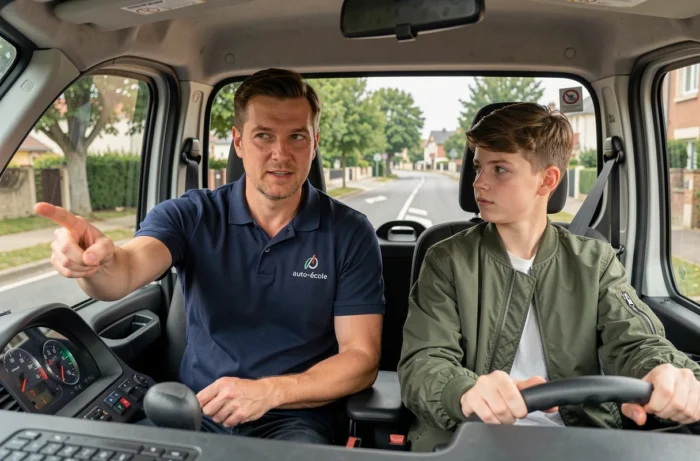
A 15-year-old student enrolled in accompanied driving receives their initial training completion certificate, but the driving school warns them: no practical exam dates are available for several months. This gap between the legal timeline and the reality of exam slots changes the strategy to obtain a driver’s license as soon as possible.
Practical exam delays: the constraint that no one plans for
Most guides detail the age requirements and administrative steps. In practice, the factor that truly delays obtaining the license is the availability of practical exam slots. In September 2026, driving schools in Lot reported that their students could start driving without securing a slot until January, resulting in several months of waiting.
This bottleneck arises from a lack of inspectors and a surge in registrations. For a young person aiming for their license at 17, this means they need to anticipate registration well in advance. Waiting until they have completed their driving hours to book a date pushes the deadline back by several weeks, sometimes more.
This risk can be mitigated by enrolling in a driving school that reserves exam slots through the RDV Permis platform as soon as the initial training is completed, without waiting for the student to finish all their hours. Online schools sometimes offer slots in less saturated centers, but feedback on this varies by department. To better understand the conditions and available pathways, one can consult the DreaMotors website before choosing their path.

Accompanied driving from 15: the pathway that shortens the probationary period
Accompanied driving (AAC) remains the most advantageous pathway for a young person who wants to drive early. Registration for the highway code is possible from 15 in this pathway, compared to 16 in the traditional route. Once the code is obtained, the student undergoes initial training at a driving school, receives their certificate, and then drives with a supervisor for at least one year and 3,000 km.
Concrete advantages of AAC over the probationary license
AAC reduces the probationary period from three to two years. The accumulation of points also accelerates: the driver starts with 6 points, then recovers 3 points per year without infractions, compared to 2 points per year in the traditional route. Over two years, an AAC driver reaches 12 points. A traditional driver takes three years to achieve the same result.
This difference impacts daily life. A minor speeding offense costs one point. With only 6 points to start, each infraction feels like double the impact psychologically. Recovering points faster offers a significant safety margin.
Typical timeline to aim for a license at 17
- 15 years: enrollment in a driving school, beginning preparation for the highway code, taking the theoretical exam as soon as ready
- 15 and a half to 16 years: initial practical training (minimum 20 hours in manual transmission), obtaining the training completion certificate, beginning the accompanied phase
- 16 and a half to 17 years: accumulating kilometers with the supervisor, booking the practical exam slot in parallel, taking the test as soon as 17
This timeline assumes that the code exam is passed on the first attempt and that a practical exam slot is available. Any week lost in any of these steps pushes back the final date.
Automatic transmission: a shorter training option to consider
Taking the license on a vehicle with automatic transmission reduces the required driving hours. The legal minimum drops from 20 hours in manual transmission to 13 hours in automatic transmission. For a young person eager to obtain their license, this gain of 7 hours also represents a direct financial saving.
The trade-off: the obtained license carries the mention “automatic transmission” (code 78). The holder cannot drive a vehicle with manual transmission. To lift this restriction, they must undergo an additional 7-hour training at a driving school, available six months after obtaining the license.
In practice, more and more young drivers are opting for this route, especially in urban areas where automatic vehicles dominate rental and car-sharing fleets. Choosing automatic transmission accelerates access to the license without permanently closing the door to manual.
ANTS registration and NEPH number: the administrative steps not to delay
First and foremost, the candidate must obtain a NEPH number (Harmonized Prefectural Registration Number) on the ANTS website. This process is free and entirely online. The NEPH is mandatory for registering for both the code exam and the practical test.
Documents to gather for the application
- Valid identification (national identity card or passport)
- Proof of residence dated within the last six months
- Digital identity photo in the regulatory format (e-photo)
- For foreign candidates outside the EEA: valid residence permit and residency in France for at least six months
The processing time for the NEPH varies, but it generally takes at least a few working days. Starting this process at the beginning of code preparation avoids unnecessary downtime between the end of theoretical training and registration for the exam.
Code exam: cost and organization
The theoretical test costs 30 euros with an accredited operator (La Poste, SGS ObjectifCode, Dekra, Code’nGo, Bureau Veritas). A slot can be booked online, often within the week. It is one of the few steps in the process that does not suffer from significant waiting times.
The code obtained remains valid for five years. Even in the event of failure in driving, there is no need to retake it as long as this period is not exceeded.
Obtaining a driver’s license at 17 remains a realistic goal, provided that AAC is started early enough and that the practical exam slot is booked without waiting for the completion of driving hours. The main variable to adjust is not the training, but the schedule of available slots in the department.